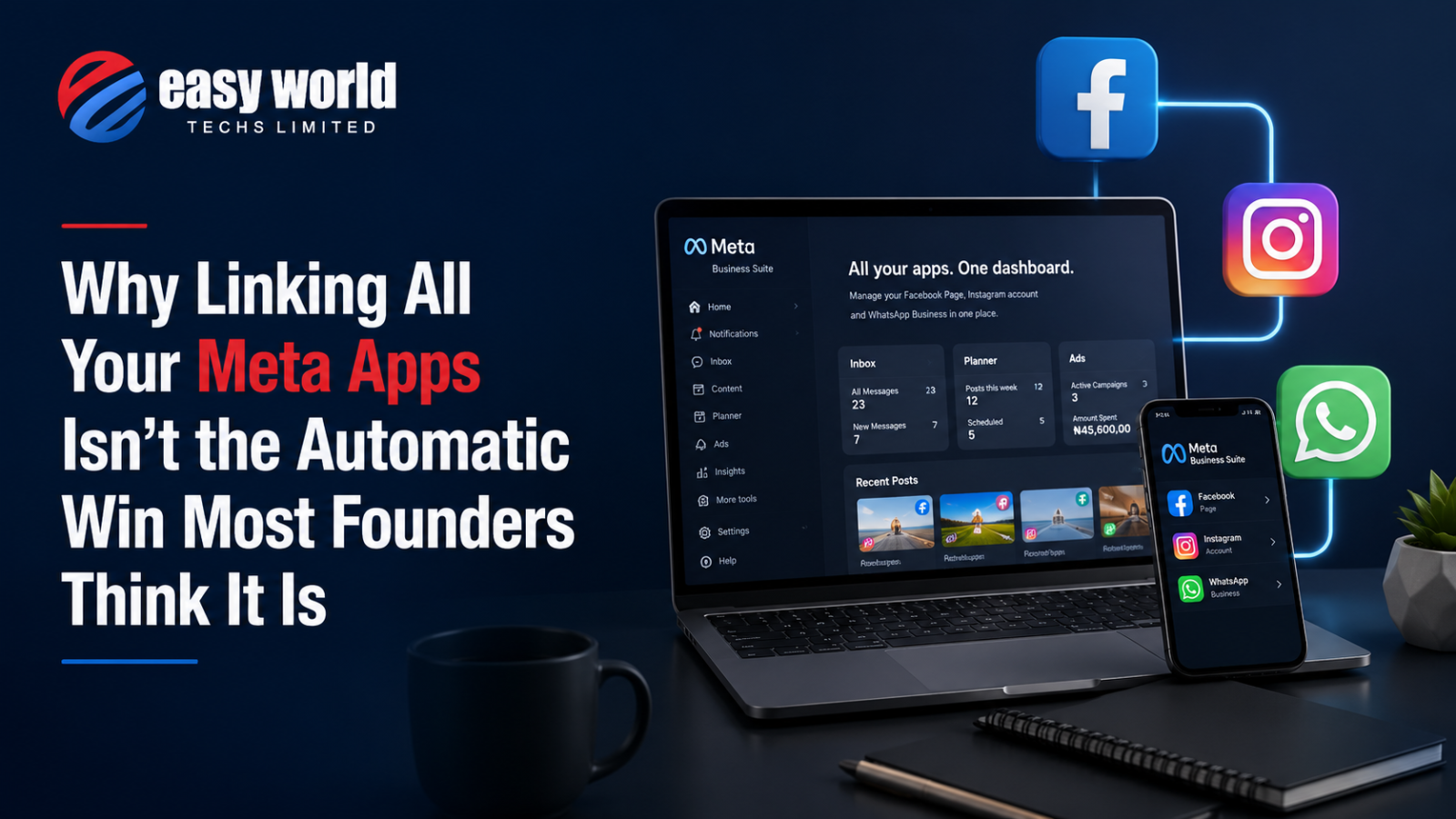
Every social media "best practices" thread will tell you to link your Facebook Page, Instagram account, and WhatsApp Business number through Meta Business Suite. It sounds like basic hygiene — the kind of thing you do without thinking twice, the same way you'd set up a business email instead of using Gmail. Most guides frame it as pure upside: one inbox, one content calendar, one dashboard.
That's true. It's also incomplete.
What you actually get
The pros are real, and they're worth naming clearly, not just for balance:
- One inbox for Facebook Messenger, Instagram DMs, and WhatsApp messages. If you're a small team answering customer questions across three apps, this alone saves hours a week.
- Post once, publish to Facebook and Instagram simultaneously, instead of duplicating the work manually.
- Ads Manager runs campaigns across both platforms from a single dashboard, which matters if you're advertising with a limited budget and want to avoid managing separate ad accounts.
- If you sell products, your catalog can sync across Instagram Shopping and Facebook Shop instead of you updating two separate listings every time stock changes.
- Team access without handing out personal passwords — you can grant a staff member or agency partner access to the Page without giving them your actual Instagram login.
For a lean team — which describes most of the businesses we work with — this is genuinely useful. The time saved on cross-posting and message management alone is probably the single biggest reason small businesses adopt it, though we don't have hard numbers specific to Nigerian SMEs to back that with precision.
What almost nobody tells you
Here's the part that gets skipped in the "just link everything" advice: linking your accounts also links your risk.
Meta treats a linked set of accounts as one connected asset, not three independent ones. This shows up in a few ways worth understanding before you commit your whole business to it:
Account restrictions can cascade. If your Facebook Page gets flagged — for a policy violation, a payment dispute, unusual activity, or even a false positive from Meta's automated moderation — the linked assets attached to that Business Manager can be affected too. Multiple sources tracking Meta's 2026 enforcement patterns describe restrictions spreading across linked accounts once one asset in a Business Portfolio gets flagged, particularly around ad account issues. The exact scope of what gets frozen and under what conditions isn't something Meta publishes in detail, so treat this as a real risk pattern rather than a guaranteed mechanic.
You're now dependent on one identity. Linking requires a personal Facebook profile behind the Page — you can't connect purely through a Page with no personal account attached. If that personal profile has an issue (which happens more often than people expect, especially with Meta's stricter identity verification pushes), it can affect your ability to manage the business assets tied to it.
Recovery gets slower, not faster. When something goes wrong with one linked account, you're often troubleshooting three products' worth of settings, permissions, and support tickets to fix it — instead of dealing with one isolated problem on one platform.
You lose platform-specific flexibility. Once everything runs through one unified system, some businesses find themselves managing all three channels with the same tone, same cadence, same content — because the tool nudges you toward "post once, publish everywhere." Instagram audiences and WhatsApp customers often expect different things from you. Convenience can quietly flatten a strategy that should have stayed differentiated.
The mistake we actually see
The common mistake isn't linking the accounts. It's linking them and then treating that single dashboard as your entire digital infrastructure — no backup admin access documented anywhere, no separate record of your WhatsApp Business number's verification status, no plan for what happens if the Business Manager gets restricted the week before a big promotion.
Based on the pattern of support threads and account-recovery guides now common in 2026, the businesses that get hurt most by this aren't the ones who link their apps — they're the ones who link their apps and then have no idea how to operate if that link breaks, even temporarily.
What we'd actually recommend
Link the apps. The unified inbox and ad management genuinely justify it for most small businesses. But do three things most guides skip:
- Keep a second admin (a co-founder, a trusted staff member) with documented access to the Business Manager — not just you on your personal profile.
- Know your WhatsApp Business number's verification status and keep a record of it outside the Meta ecosystem, since messaging restrictions are currently one of Meta's more aggressive enforcement areas.
- Don't let "post once, publish everywhere" become your entire content strategy. Use the convenience for efficiency, not as a substitute for thinking about what each platform's audience actually wants.
The tool is useful. Treating it as risk-free infrastructure is where founders get caught off guard.