A founder we worked with last year had a title problem before he had a hiring problem. His lead developer — a genuinely talented guy who'd been with him since the beginning — was carrying the title "CTO" on LinkedIn, on the pitch deck, on the email signature. But when investors asked him about the company's technical roadmap, security posture, and hiring plan for the engineering team, he didn't have answers. He had answers about the codebase. Those aren't the same thing, and the gap between them was the first thing that made the term sheet stall.
This happens more than people admit. A business grows, technology decisions start piling up faster than anyone has time to think about them properly, and somewhere in that scramble, someone gets called "CTO" — usually the person who's been writing the most code, or the founder who's slightly less non-technical than the others. The title gets handed out like a badge of seniority rather than a description of a function. And then, six months or a year later, the business hits a wall that a real CTO would have seen coming, and nobody understands why.
The Job Nobody Actually Defined
Here's the confusion at the root of it: "CTO" sounds like a technical role, so people assume it means "the most senior developer." It doesn't. A Chief Technology Officer is a business leadership role that happens to be exercised through technology decisions. The best way we've found to explain it to founders is this — your best developer is optimizing for "does this work correctly." Your CTO is optimizing for "is this the right thing to be building, with the right people, at a cost the business can sustain, in a way that won't collapse when we're ten times bigger."
Those are different jobs. A brilliant engineer can write flawless code and still make decisions that cost a company eighteen months down the line — the wrong database for the scale you're heading toward, a stack nobody else on the team can maintain, an architecture that made sense for five users and falls apart at five thousand. We're not saying this to diminish developers; we are developers. But writing good code and steering a technology function are genuinely different skill sets, and conflating them is one of the more expensive mistakes a growing business makes.
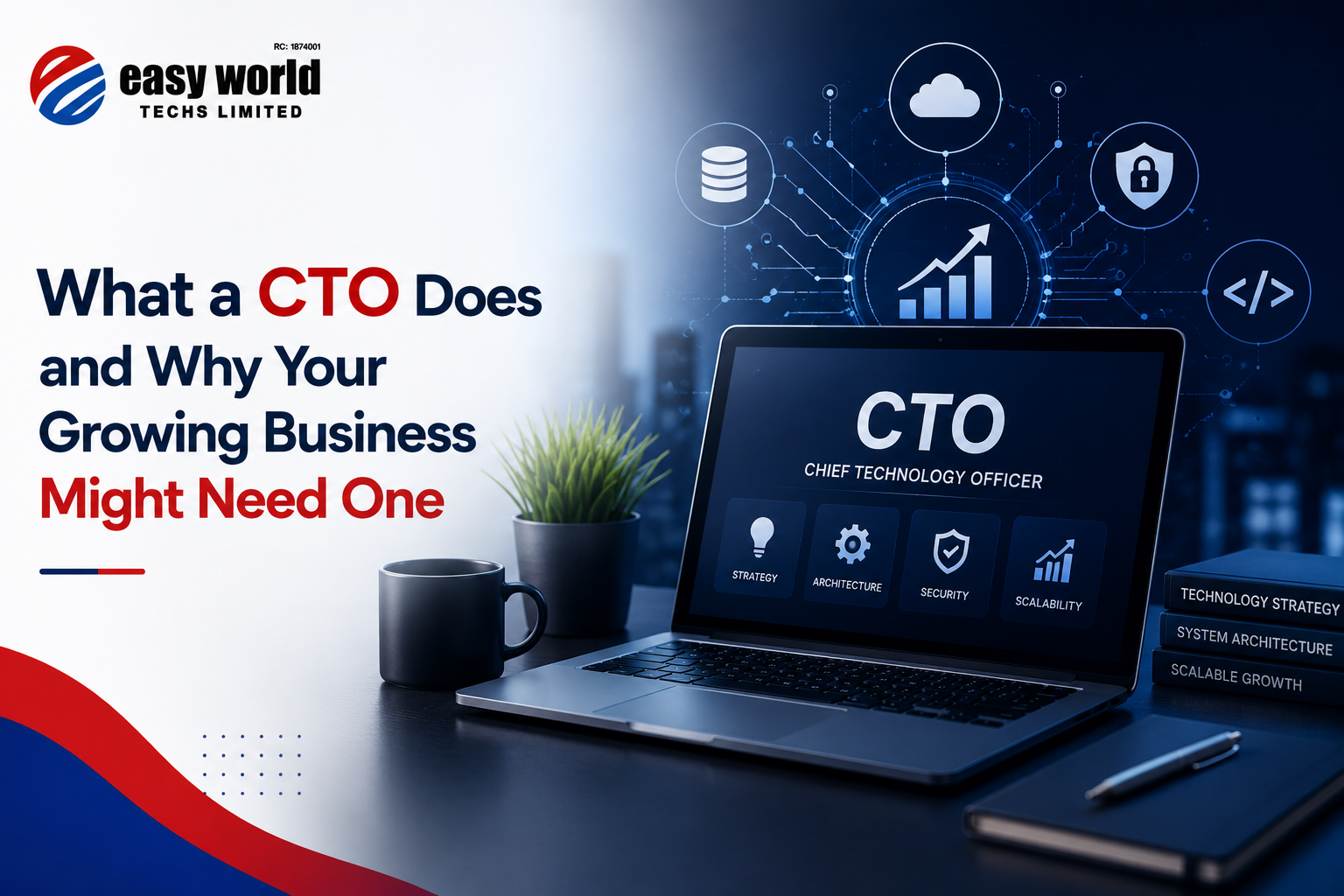
A CTO, functioning properly, is doing several things at once:
- Translating business goals into technical strategy — not "build the app," but "build the thing that gets us to the next funding round, the next thousand customers, or the next market, without requiring a full rebuild in a year."
- Making build-vs-buy-vs-outsource calls, and owning the consequences of those calls.
- Managing technical risk — security, data handling, vendor lock-in, technical debt — the things that don't show up as problems until the day they very much do.
- Hiring, structuring, and retaining a technical team, or managing the relationship with an external development partner if there isn't one yet.
- Sitting in the room when the business makes decisions that have technical implications, even if the meeting wasn't billed as a "tech meeting." Pricing changes, new markets, partnership integrations — all of these have a technical shadow, and someone needs to be thinking about it before the decision is made, not after.
Notice how little of that is about writing code. This is worth labeling clearly: some of what we're describing here reflects what we've observed working with growing businesses ourselves; some of it is a general pattern that shows up in how tech leadership tends to fail when it's absent. We're confident in the pattern. We're less certain any two businesses will hit it the same way.
The Confusion With "Technical Co-Founder"
We wrote previously about how to find and vet a technical co-founder, and it's worth being precise about the difference, because founders often use "CTO" and "technical co-founder" interchangeably when they're solving two different problems.
A technical co-founder is an equity partner from the start — someone who takes on founder-level risk, usually before there's a product or revenue, in exchange for a meaningful ownership stake. That relationship is closer to a marriage than an employment contract. You're choosing someone to build the company with, not just for it.
A CTO can be a hire. Often should be. It's a role you bring in — sometimes full-time, sometimes fractional, sometimes as a contractor for a defined period — once the business has enough scale and enough technical complexity that it needs sustained strategic ownership of the technology function. You're not giving up a piece of your company to get this. You're paying for expertise the same way you'd pay for a finance lead or a head of operations.
The mistake we see is founders treating these as the same decision, made at the same stage, for the same reasons. They're not. Founding-stage businesses without a technical co-founder usually work with development partners, freelancers, or agencies. Growth-stage businesses that have outgrown that arrangement need someone accountable for the whole technical picture — and that's a CTO conversation, not a co-founder conversation.
When You Actually Need One
There's no clean revenue number or headcount that triggers this. But there are signals, and they're worth sitting with honestly rather than reacting to on impulse.
You probably need a CTO — full-time, fractional, or interim — when technology decisions have started determining business outcomes rather than just supporting them. If your platform's uptime, your data security, or your ability to ship features on time is now a factor in whether you win or keep customers, technology has stopped being a support function and started being the business. That's a different level of risk than "our website looks a bit dated."
You probably need one when you've got more than one developer and no single person accountable for how they work together, what they're building toward, or what happens when one of them leaves. We've seen businesses lose months of institutional knowledge because the one person who understood the whole system left, and nobody had been thinking about that risk because nobody's job was to think about it.
You probably need one when you're raising investment. Investors ask technical questions that "can you code" doesn't answer. They want to know about scalability, security practices, technical debt, and whether the team can execute the roadmap. A founder without credible answers to those questions — or without someone in the room who has them — makes the raise harder than it needs to be.
And you probably don't need one yet if you're pre-product, if your technical needs are still simple enough for a competent freelancer or a small agency relationship to handle, or if hiring one now would mean diverting resources you genuinely need somewhere else first. A fractional CTO — someone who works with you a set number of hours a week or on a project basis — often makes more sense at this stage than a full-time hire. It gives you the strategic oversight without the full cost, and it's a reasonable bridge until the business is ready for more.
What Happens When the Role Stays Empty
The cost of not having this function isn't usually one dramatic failure. It's a slow accumulation of decisions that seemed fine individually and add up to a mess collectively. A payment integration chosen because it was quick, not because it was right for where the business was heading. A hosting setup nobody's reviewed since launch. A codebase three different developers have touched with three different conventions, none of them documented. None of this shows up on a balance sheet. All of it shows up eventually, usually at the worst possible time — during a funding round, a security incident, or a scaling moment the business wasn't technically ready for.
We're not saying every growing business needs to rush out and hire a CTO tomorrow. We are saying the decision deserves to be made deliberately, with a clear sense of what the role actually does, rather than by default — by handing the title to whoever's closest to the keyboard and hoping the strategic thinking happens on its own. It rarely does. Someone has to own it on purpose.
If you're at the point where technology decisions feel bigger than any one person on your team is equipped to own, that's usually the signal worth paying attention to — whatever the eventual solution ends up looking like.