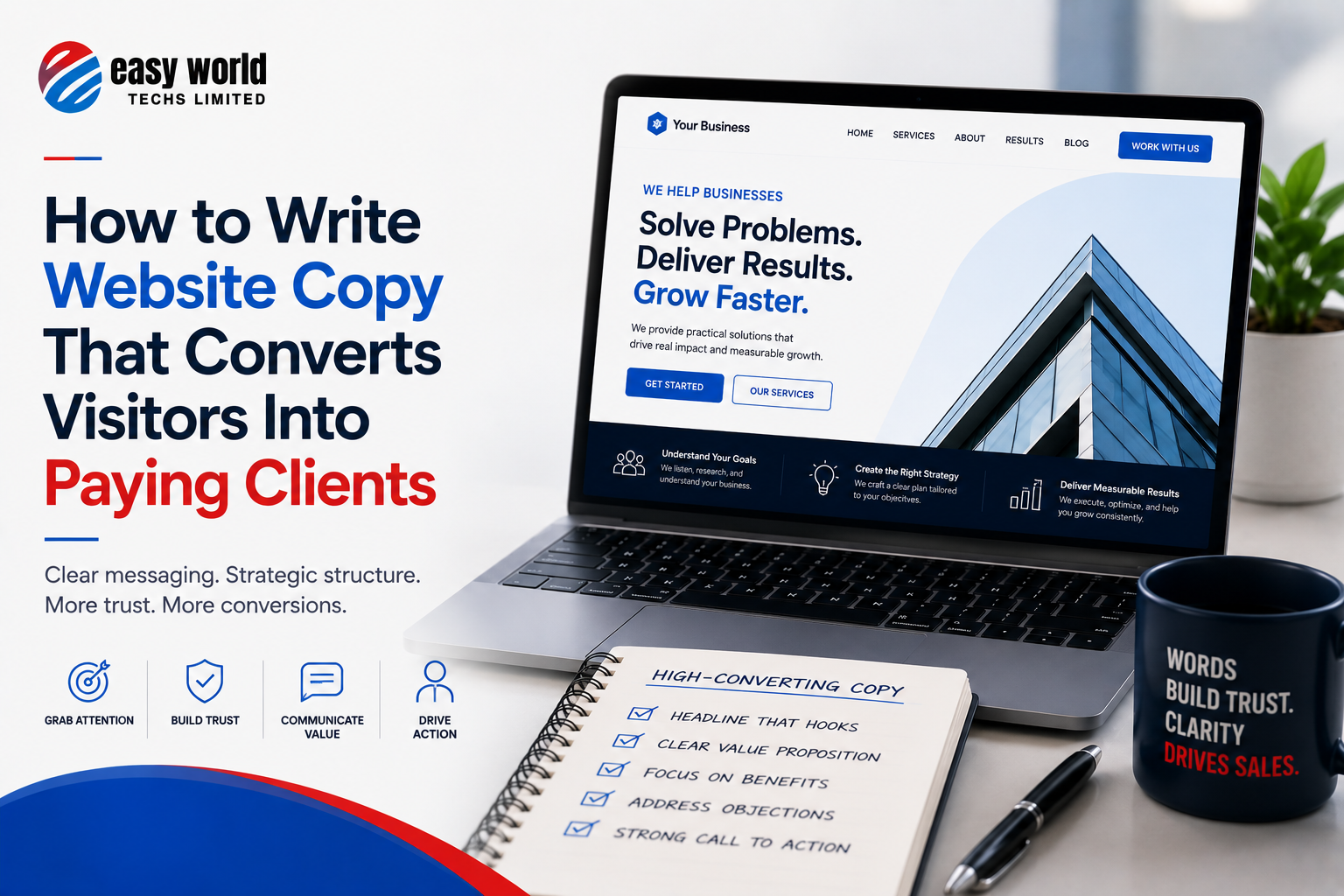
Here's a sentence we've seen on more Nigerian business websites than we can count: "We are a dynamic and innovative company committed to delivering excellent solutions to meet all your needs." Read it again. Now try to explain what the company actually does. You can't, because it doesn't say. It's not bad because it's poorly written — grammatically, it's fine. It's bad because it communicates nothing, and a visitor who's spent four seconds on your homepage without learning anything concrete about what you do or why they should care is a visitor who's about to leave.
This is the most common copy problem we see, by a wide margin, and it's worth naming directly: most business website copy is written to sound impressive rather than to be understood. Those are different goals, and the second one is the only one that actually converts anyone into a paying client.
Why "Professional-Sounding" Copy Actually Underperforms
There's a reason business owners gravitate toward vague, confident-sounding language — it feels safe. "Dynamic," "innovative," "excellent," "world-class" — these words don't commit to anything specific, so they can't be wrong. But that safety comes at a real cost. A visitor reading your homepage isn't evaluating whether you sound professional in the abstract. They're asking a much more specific, self-interested question: does this business solve my specific problem, and can I trust them enough to find out more. Vague language can't answer that question, no matter how polished it sounds, because it was never actually saying anything a reader could evaluate against their own situation.
Specific, concrete language does the opposite work, even when it sounds less impressive on the surface. Compare these two openings for the same hypothetical accounting firm:
Vague version: "We provide comprehensive financial solutions tailored to help businesses achieve their goals through innovative accounting practices."
Concrete version: "We handle bookkeeping, tax filing, and payroll for small businesses in Port Harcourt, so you're not scrambling before FIRS deadlines or guessing whether your numbers are right."
The second one is longer and less "polished" in the traditional sense. It's also immediately useful to anyone reading it. A business owner who's been scrambling before a tax deadline recognizes their own situation in that sentence within seconds. Nothing in the first version gives them anything to recognize.
The Structural Mistake: Leading With Yourself Instead of the Reader's Problem
Beyond word choice, there's a structural issue that shows up constantly. Most business homepages open with the company — who we are, what we believe, our mission — before ever addressing the visitor's actual situation. That ordering feels natural to write, because you're naturally thinking about your own business first. It's the wrong order for a reader, who arrived with a specific problem or question and is scanning, not reading, to see if you're relevant to it.
The copy that converts tends to flip this: lead with the reader's situation, then position the business as the answer to it, then get into who you are and why you're credible. A web development agency's homepage doesn't need to open with "Founded in 2018, we are a team of passionate developers." It can open with the actual problem a visitor showed up with — "Your competitor's website is outranking yours, and it's costing you customers who never even find you" — something that makes a specific reader stop scrolling because it names their exact frustration, before asking them to care about the company's founding story at all.
Specificity Beats Superlatives, Every Time
"Best," "leading," "top" — these words are so overused across every industry that readers have learned to tune them out entirely, the same way we've all learned to ignore banner ads. Nobody believes "the leading web development agency in Port Harcourt" because every competitor's homepage says some version of the same thing, and there's no way to verify it, so it registers as noise rather than information.
What actually builds credibility is specific, checkable detail. "We've built 40+ websites for Nigerian SMEs since 2015" is a claim a reader can mentally weigh. "Our clients typically see enquiries increase within the first month of launch" is a claim that invites the obvious follow-up question — "how much, and can you show me" — which is exactly the kind of curiosity that keeps someone reading toward your contact form instead of clicking away. Vague superlatives close the conversation because there's nothing to engage with. Specific claims open it, because they give the reader something concrete enough to be curious about.
Write to One Person, Not to "Everyone"
A lot of vague copy comes from trying to appeal to every possible visitor at once — every industry, every business size, every budget — out of a fear of narrowing the audience and losing potential clients. This backfires. Copy written to appeal to everyone ends up meaningfully connecting with no one, because it can't be specific enough to resonate with anyone's actual situation without excluding someone else's.
The stronger approach is writing as if you're addressing your single best-fit client directly, even if your actual customer base is broader than that. A logistics software company writing for "any business that ships things" produces generic copy. The same company writing specifically for "e-commerce businesses in Lagos struggling to track delivery status across multiple riders" produces copy that speaks directly and convincingly to that exact reader — and, counterintuitively, still works reasonably well for adjacent businesses who recognize enough of their own situation in it, because specificity reads as expertise even to people slightly outside the exact description.
What This Looks Like in Practice: A Quick Before/After
Take a common section: the "why choose us" block that appears on nearly every service business website in some form.
Typical version: "Why Choose Us: Quality service, experienced team, customer satisfaction, competitive pricing."
This is a list of things every competitor also claims, in the same generic language, which means it persuades nobody of anything, because it doesn't distinguish this business from any other business making the identical claims.
Rewritten version: "You'll deal directly with the developer building your site — not a salesperson relaying messages to a team you never speak to. We show you working versions of your site as we build it, not just at the end. And if something breaks after launch, you're calling a number that gets answered, not submitting a ticket into a queue."
The rewrite doesn't use a single superlative. It doesn't claim to be the best at anything. It just describes specific, checkable things this business actually does differently, framed around frustrations a reader has likely experienced with other vendors before. That's the entire mechanism behind copy that converts — not better adjectives, but more honest specificity about what a reader will actually get.
The One-Sentence Version of All of This
If you take nothing else from this: before publishing any page on your website, read it back and ask whether a stranger with your exact problem would understand, specifically, what you do and why it matters to them — not whether it sounds impressive. Impressive-sounding copy gets skimmed and forgotten. Specific, honest copy gets read, remembered, and acted on, because it was written for the person reading it instead of for how the business wanted to sound.