Someone in your city is looking for what you do. Right now. They pull out their phone, type "accounting services near me" or "website design in Lagos" or "plumbing in Port Harcourt," and they see a map with business listings.
Your competitor appears on that map. You don't.
That person moves on to the next result.
This happens dozens of times a month, and you never know about it.
What Actually Is a Google Business Profile?
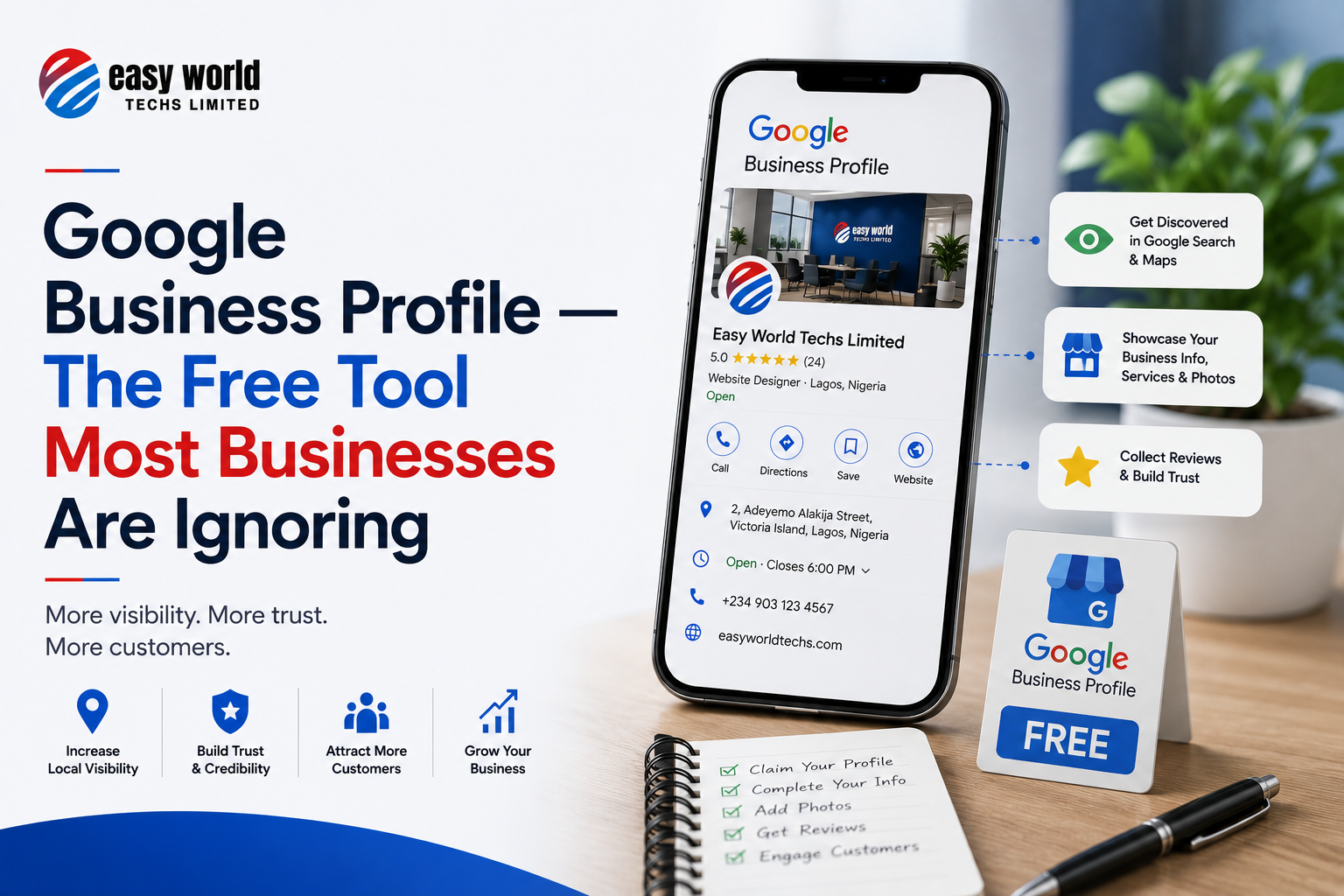
Let's start with the unsexy part: a Google Business Profile (formerly Google My Business) is a free listing on Google. When someone searches for a service or business type + a location, your profile shows up in the map results and search results. It includes your address, phone number, hours, website, photos, and customer reviews.
That's it. Simple tool. No monthly fee. No hidden costs.
But here's what matters: if you're a service business, local business, or anyone who serves customers in a geographic area — this is the single highest-leverage, lowest-effort marketing tool you can set up. And most businesses either don't have one, or have one that's half-abandoned and outdated.
Why You're Losing Money Without Knowing It
There are two types of businesses reading this. Let me speak to both.
Type 1: You don't have one set up yet.
This one is straightforward. Someone is searching for your service. Google is showing your competitors instead. You're invisible.
The percentage of service businesses that lose customers this way is probably significant — we know local search is a primary way people find businesses now — but without access to your actual search data, I can't tell you exactly how many potential customers you're missing. But the number isn't zero. It's likely not even small.
Type 2: You have one, but it's barely maintained.
This is more insidious because you think you're covered.
Your profile exists. It has your name, address, and phone number from five years ago. No recent photos. No posts. The hours might be wrong. You have five reviews, three of them critical, and you've never responded to any of them.
When someone finds you on Google, they see a business that looks abandoned. Or worse, they see complaints about your service with no response from you. That doesn't inspire confidence.
The profile you set up once and forgot about is often worse than no profile at all.
How This Actually Works (And Why It Matters More Than You Think)
When someone searches for your service type + location, Google is doing two things:
- Finding businesses that match what they're looking for — You need to be listed, categorized correctly, and have the right information in your profile so Google knows what you do.
- Ranking those businesses — Google's algorithm considers several factors: how close you are to their location, how many reviews you have, how recent those reviews are, how you respond to reviews, how complete your profile is, and how often your profile is updated.
This ranking isn't a mystery algorithm — the factors are relatively clear and consistent. More reviews, newer reviews, active management, complete information, and profile updates all signal to Google that you're a legitimate, active business worth showing at the top of the list.
This is why your competitor who has 47 reviews and responds to every one appears above you.
Who Actually Needs This (And Who Maybe Doesn't)
Let's be honest about scope. A Google Business Profile works best if:
- You serve customers in a specific geographic area (local plumber, accountant, salon, repairs, consulting, services)
- You have a physical location customers can visit or you operate in a defined region
- Your customers search for you (rather than you reaching out to them)
If you're a purely online business, a B2B SaaS company selling globally, or someone who only works through referrals, this is less critical. Not useless — a complete business profile still helps credibility — but it's not your primary customer acquisition channel.
If you're a local service business and don't have one set up, this is urgent. If you have one and haven't updated it in months, this is worth an afternoon this week.
What Actually Happens When You Set This Up Properly
Here's the thing that doesn't get enough attention: a well-maintained Google Business Profile doesn't just make you visible. It starts a feedback loop.
- You show up in local searches — People see you when they're actively looking
- They see reviews and ratings — Trust is built before they ever call you
- You respond to reviews and questions — You look engaged, professional, and attentive
- More people interact with your profile — Calls, website clicks, direction requests
- Google sees the activity — Your ranking improves because you're active
- You show up even higher — The loop continues
Compare this to a dormant profile where none of those signals are firing. Google essentially deprioritizes it.
Based on how search ranking algorithms work across platforms, an active, well-reviewed profile in a competitive area could realistically capture 20-40% more of the local search traffic than an inactive one. But again, I don't have data specific to your business or market, so that's a principle-based estimate.
How to Actually Use It (Not Just Set It Up)
Setting up a profile takes 20 minutes. Using it effectively takes a bit more intentionality.
Minimum viable effort:
- Claim your profile (search your business name on Google, or go directly to google.com/business)
- Fill in all fields accurately — address, phone, hours, website, service areas, categories
- Add at least 10 good photos (storefront, products, team, workspace — whatever shows what you do)
- Add a written description of what you do in plain language
- Set up notifications so you know when customers leave reviews
- Respond to every review — positive or negative. Takes 30 seconds. Shows you're paying attention.
What actually moves the needle:
- Post regularly (doesn't need to be daily — monthly is fine) — updates, seasonal offers, staff introductions, photos of recent work
- Encourage satisfied customers to leave reviews — mention it verbally, email follow-ups, or a simple link
- Ask specific questions in your review responses — this creates dialogue and shows you're engaged
- Keep information updated — if hours change, update immediately. If you open a new location, add it. Outdated information erodes trust.
The difference between a profile that's "fine" and one that actually generates business is the difference between setting it up and then maintaining it.
The Actual Cost of Ignoring This
Let's talk money.
Say you're a service business in a mid-sized market. You probably get maybe 5-20 qualified leads per month from local search, depending on your market and how competitive it is. If 30% of those convert to customers, and your average customer is worth $500-2000 in revenue, you're talking about $750-$12,000 in monthly revenue coming from local search visibility.
If you're completely invisible because you don't have a profile, or completely overlooked because your profile is dead, you're not getting that revenue. Or you're getting 20% of it because your competitor's profile is better.
That's not a small thing.
And the setup cost? Zero dollars. The maintenance cost? An hour a month if you're thorough.
The math is hard to argue with.
Why More Businesses Aren't Doing This
If this is so valuable and free, why isn't every business crushing this?
A few reasons:
Assumption #1: "I'm on Google, so people can find me."
Being on the internet and being findable in local search are different things. Just because Google has indexed your website doesn't mean your business profile is set up or active.
Assumption #2: "This is too technical for me."
It's genuinely not. The interface is designed for non-technical business owners. If you can fill out a form, you can do this.
Assumption #3: "I'm too busy."
You're too busy to spend 20 minutes setting up a channel that could generate thousands of dollars in revenue? That math doesn't check out. And the maintenance is genuinely minimal.
Assumption #4: "My customers don't search for me online."
Maybe. But probably more of them do than you think. And they're definitely searching for someone offering what you do. If that someone isn't you, your competitor wins.
A Different Way to Think About This
Here's a reframe: a Google Business Profile isn't a marketing tool. It's a findability tool.
You're not trying to convince anyone. You're not trying to sell. You're making sure that when someone is already looking for what you do, they can find you easily. You're answering their questions. You're building trust through reviews and responsiveness. You're showing up.
That's it. That's the whole game.
Most businesses are so focused on complicated marketing strategies — paid ads, content marketing, funnels — that they completely miss the fact that the simplest, cheapest lever they have is making sure someone who's already looking for them can actually find them.
Set up your profile. Maintain it. Respond to reviews. Post occasionally. Watch what happens.
You'll probably be surprised by how many of your competitors still aren't doing it.