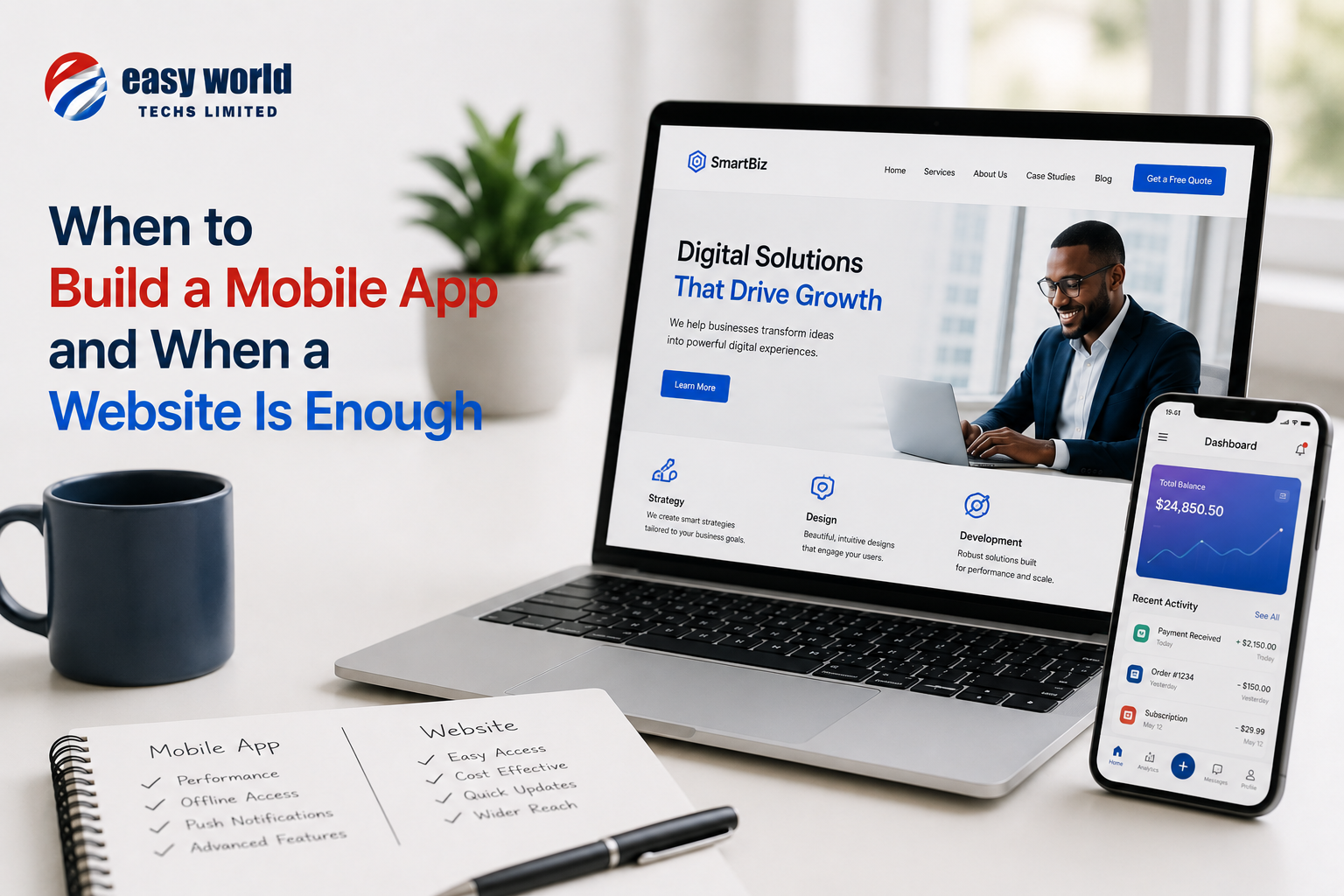
Every few weeks someone walks into a conversation with us having already made up their mind. They want a mobile app. They have seen what their competitors are doing, or they have an idea they are excited about, or someone told them that apps are the future and websites are old news. They are not looking for advice. They are looking for someone to build what they have already decided they need.
And sometimes they are absolutely right. But sometimes — more often than people expect — what they actually need is a well-built website, and a mobile app would be an expensive detour that solves a problem they do not really have.
This piece is for anyone standing at that fork in the road. Not sure which direction to go, or not sure if they should question the direction they have already chosen.
Why This Decision Matters More Than People Realise
Building a mobile app is not like adding a new page to your website. It is a different category of investment — in time, money, and ongoing commitment. A decent mobile app for a Nigerian business, built properly with real functionality, is a significant undertaking. Then there is the maintenance. Operating system updates, device compatibility, app store compliance, bug fixes, new feature requests from users. A mobile app is not a project you finish. It is a product you operate indefinitely.
A website, on the other hand, can be built faster, updated more easily, works on every device with a browser, and does not require your users to download anything before they can interact with your business.
Neither is inherently better. They are different tools with different use cases. The mistake is choosing based on what sounds more impressive rather than what actually fits the problem you are trying to solve.
Start With Your Users, Not Your Idea
The most useful question to ask before anything else is not "do I want an app?" It is "how will my users actually interact with this?"
If the answer is that people will visit occasionally — to check your services, make an enquiry, book an appointment, read content, or make a one-time purchase — a website handles that perfectly. There is no compelling reason for a user to download an app they will open three times a year. Most of them will not bother downloading it at all, and the ones who do will delete it within a month to free up storage.
But if the answer is that users will come back frequently, need real-time updates, want a personalised experience that remembers them and their preferences, or need to do something the moment they think of it — that is a different story. That is where an app earns its place.
Think about the apps on your own phone that you actually use regularly. Most of them share something in common. They give you a reason to open them often. They know who you are. They work even when your connection is weak. They send you a notification at exactly the right moment. A website cannot do most of those things as effectively.
Build a Mobile App If These Sound Like You
Your users need frequent access and real-time interaction. If your product only works when people engage with it regularly — a delivery tracking service, a financial platform, a social community, a loyalty programme — an app creates a direct line to your users that a website simply cannot match.
Offline functionality is part of the experience. Some services need to work without an internet connection. Field workers logging data, users saving content for later, drivers navigating routes in areas with poor signal. If your core functionality needs to survive without connectivity, an app can cache data and operate offline in ways a standard website cannot.
You need access to device features. Camera, GPS, push notifications, contacts, biometric authentication, accelerometer. If your product genuinely requires any of these to function well, an app is the appropriate delivery mechanism. A ride-hailing service without GPS is not a ride-hailing service. A health monitoring tool without access to the device's sensors is missing its entire reason for existing.
Personalisation is central to your value proposition. Apps are exceptional at learning user behaviour and delivering tailored experiences. If remembering preferences, surfacing relevant content, or customising the interface per user is core to what makes your product valuable, an app gives you far more control over that experience.
You are building for customer retention, not just acquisition. This is an important distinction. Websites are often better at the top of the funnel — attracting new visitors, communicating what you do, converting strangers into first-time customers. Apps tend to shine further down the funnel — keeping existing customers engaged, building habit and loyalty, reducing churn. If retention is the problem you are solving, an app is a serious tool for that.
A Website Is Enough If These Sound Like You
You are just getting started. If your business is new and you are still figuring out product-market fit, the worst thing you can do is sink your early capital into a mobile app before you know whether the core business model works. A website gets you live, visible, and generating feedback fast — at a fraction of the cost. Validate first. Build the app when you have proof that people want what you are offering and are willing to pay for it.
Your audience visits occasionally for information or transactions. If someone needs to find your opening hours, read about your services, request a quote, or make a booking once every few months, there is no value exchange that justifies asking them to download an app. A fast, well-designed website with a clear call to action does everything that interaction requires.
Your primary goal is content, information, or lead generation. Blogs, portfolios, corporate websites, news platforms, service businesses — if your main job is to communicate what you do and give people a way to reach you, a website is the natural and sufficient answer.
Your budget has limits. This is just practical. A properly built mobile app costs significantly more than a website, takes longer to deliver, and requires ongoing investment to maintain. If your budget is limited and you need to choose, a strong website almost always gives you better return on that investment — especially in the early stages of a business.
You need to update content frequently without technical help. A website with a content management system lets your team add blog posts, update service descriptions, change pricing, and upload new images without touching code. App updates require going through a development cycle and, for significant changes, resubmitting to the app stores for review. For content-heavy businesses, the website's agility is a genuine advantage.
The Grey Area — Progressive Web Apps
Worth mentioning because they sit interestingly between both worlds. A Progressive Web App (PWA) is essentially a website that behaves more like a native app. It can be added to a user's home screen, work offline to a degree, send push notifications, and load almost instantly. For businesses that want some of the app experience without the full cost of native development, PWAs are worth exploring seriously. They are not right for every use case but they close the gap more than most people realise.
The Question Nobody Asks But Should
Before you commit to either direction, ask yourself honestly: am I choosing this because it is the right solution for my users, or because it sounds more impressive to say I have an app?
There is no shame in the second answer — it is a very human motivation. But it is an expensive way to make a technology decision. An app that your users do not regularly open is a sunk cost. A website that clearly communicates your value and converts visitors into clients is a business asset.
Build what your users need. Not what looks good in a pitch deck.
A Quick Way to Think Through the Decision
If your users will interact with your product daily or several times a week — lean toward an app.
If your users need offline access or device-level features — build an app.
If you are validating an idea or launching on a limited budget — start with a website.
If your goal is to attract new customers and communicate your offering — a website does that job.
If retention, loyalty, and repeat engagement are your primary challenges — an app earns its cost.
If you are still not sure after working through all of this — talk to someone who has built both and can look at your specific situation without a vested interest in steering you toward the more expensive option.
We have had that conversation with dozens of businesses across Nigeria. Sometimes the right answer is an app. Sometimes it is a website. Sometimes it is a website now and an app in eighteen months when the business has grown into the need for one. The answer is always specific to the business, the users, and the resources available.
What it is never based on is what sounds better.
Easy World Techs Limited builds mobile apps and websites for businesses across Nigeria — and we will tell you honestly which one your situation actually calls for. Based in Port Harcourt, Rivers State.