A developer told me something that stuck with me: "Most of my project delays aren't because I'm slow. They're because the brief was so unclear that I built the wrong thing the first time."
I've seen this happen. I've watched a founder spend weeks in frustrated conversations with a developer about why something isn't what they imagined, only to realize: the brief was three sentences on WhatsApp.
Here's what's maddening: writing a good brief doesn't take that much longer than writing a bad one. It takes maybe 30% more time and effort upfront. But it saves 300% of the time in rework, clarification, and frustration later.
Most founders don't do this because they assume developers just understand what they want. "Build me an e-commerce site" should be clear enough, right?
It's not. And the disconnect between what you thought you communicated and what your developer built is where most projects go sideways.
What a Bad Brief Looks Like
I'm not going to mock it. I've written bad briefs. Most people have. Here's a real example, modified slightly to protect the client:
"We need a website for our consulting business. Should have a homepage that explains what we do, a services page, a contact form, and a blog. We want it to look modern and professional. We have a logo already. Make it mobile-friendly. We'll launch in two months."
That's actually not the worst brief I've ever seen. But look at what's missing:
Who is this for? Investors? Clients? Local businesses? Governments? Each would lead to different design and messaging.
What does "modern and professional" actually mean? To you, that might mean minimalist and elegant. To the developer, it might mean lots of features and flashy interactions. You're both imagining different things.
What specifically goes on these pages? Does the homepage have testimonials? Case studies? Pricing? A video? How many services? How detailed?
What happens with the blog? Is it a marketing tool to attract SEO traffic? Is it thought leadership? Is it once-per-week or once-per-month? Who writes it?
What about the contact form? Does it go somewhere specific? Do you need a CRM integration? Do you want to be notified immediately or daily digest?
What does "two months" actually mean? Is that a hard deadline or flexible? What's the priority if we have to cut scope?
This brief sounds clear until someone has to actually build to it. Then it becomes clear that "clear" isn't the same as "actually specified."
What a Good Brief Actually Includes
A good brief isn't long. Sometimes it's shorter than a bad brief. The difference is specificity.
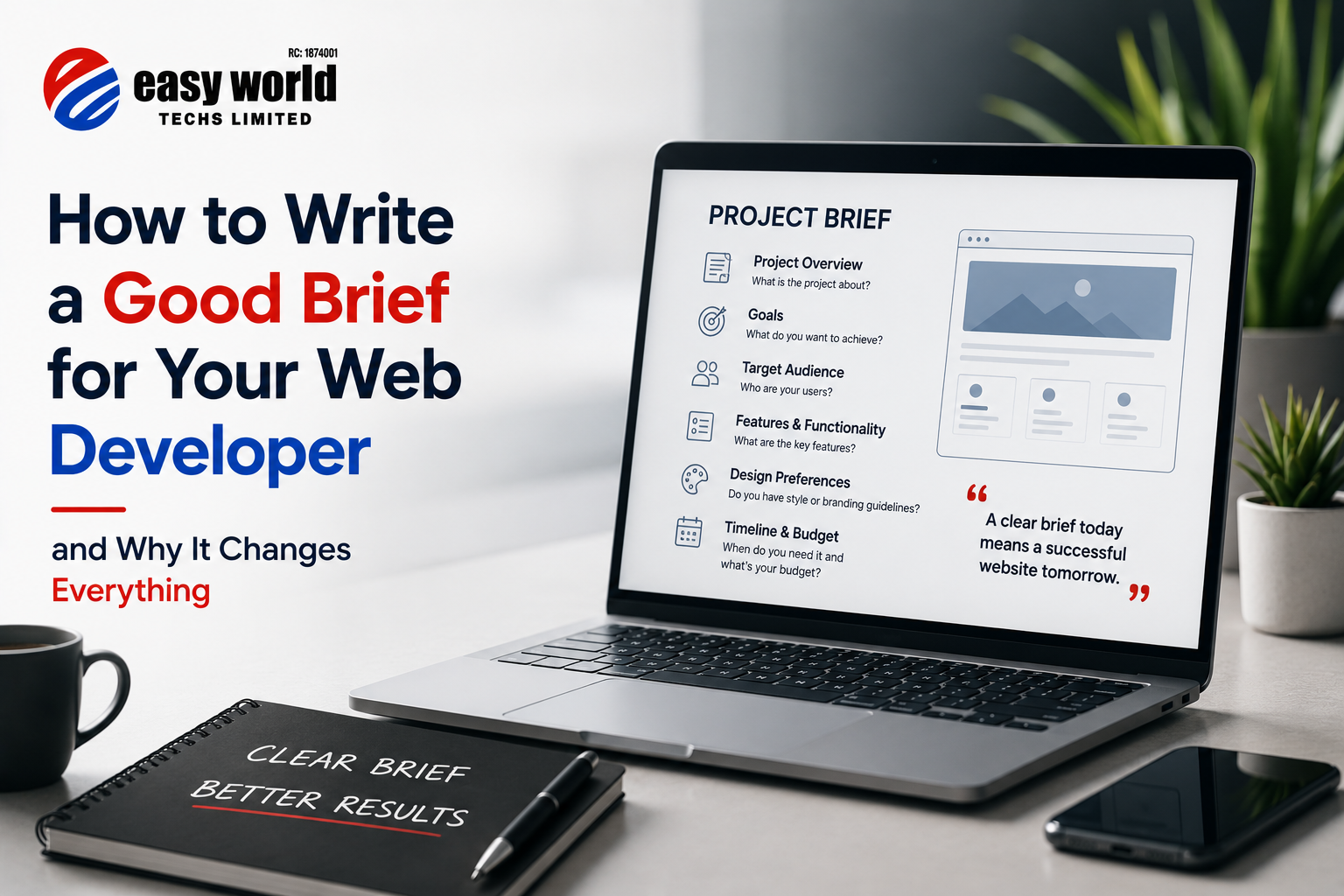
Here's what you actually need:
The core purpose, in one sentence. Not "we're a consulting business." But: "We help manufacturing companies in Nigeria reduce production downtime through operational consulting. The website needs to attract company owners who have heard about us through referrals and want to learn more before calling us."
That one sentence tells your developer who the site is for, what problem it solves, and how it will be used. Everything else flows from that.
Who you're building this for, and what they actually do on the site. "Our primary visitor is a manufacturing plant manager or owner, probably between 40-55, usually doesn't have time to browse long. They come because they heard about us from someone in their network. They want to: (1) Quickly understand what we do, (2) See that we've done this before, (3) Know how to contact us. They don't care about blog posts or case studies as features, but they want to see evidence that we know their specific problems."
That description tells the developer how to prioritize. The blog isn't for these people, so it shouldn't take up space. The homepage needs to be fast to scan. Social proof matters.
Specific examples of what you want. Not "modern design," but: "Similar to the feel of joeadinma.com, but adapted for our service type. We like how they use clear section headings, credibility signals upfront (credentials and years in business), and straightforward language that doesn't oversell. We want it to feel trustworthy and technical, not sales-y. More like a professional who knows what they're doing, less like someone trying to convince you."
Or: "We want the navigation and layout like a professional services site—clean, scannable, credible-feeling—but with warmer color choices and more personality in the copy. Authority without being stuffy."
This is where real URL references help. Not to copy directly, but to show what resonates with you.
The specific pages and what's on them.
Homepage:
- Hero section with one clear statement of what we do
- Section showing 3-4 case studies (each with: what the problem was, what we did, what the result was)
- How to contact us (email or calendar link to book a call)
Services page:
- Overview of each service (keep it brief, one paragraph each)
- For each service, one example of how it's helped a client
Team page:
- Photo and bio for each person
- What they specialize in
Contact:
- Form with: name, email, company, description of their situation, preferred contact method
- Confirmation message after submission
- Email notification to your inbox
Blog:
- Posts we've written on operations topics
- Searchable/filterable by topic
- "Subscribe to updates" option
This is specific. Your developer knows exactly what pages exist and what content goes on each. They're not guessing.
How success is measured. Not "lots of traffic." But: "In three months, we want to get 10-15 qualified inquiries per month through the website contact form. We'll measure success by: (1) People who submit the form and actually call us, (2) Feedback from sales team on lead quality, (3) Monthly traffic to the site."
This tells the developer what matters. It's not about being beautiful. It's about people taking action.
Technical specifics if you have them. Do you need e-commerce? CRM integration? A membership area? Customer login? Do you have existing tools (like email newsletter, CRM, etc.) that the site needs to connect to? What's your budget for hosting/domain per month?
Timeline and priority. "We'd like this in 8 weeks. The must-have items are: homepage, services pages, contact form, ability for us to add blog posts. Nice-to-have: team page, search functionality, email subscription. If we're running late, we can launch without the nice-to-haves."
This tells the developer what doesn't compromise and what can be cut if needed.
Real-world example: This structure is based on how effective professional services sites like joeadinma.com (chartered accountants, Port Harcourt) actually work. Notice how they immediately establish: (1) what they do, (2) who they serve (oil and gas, trading, construction companies), (3) credibility signals (ICAN fellow, established 2010), (4) how to get started (consultation booking). Everything is specific. Nothing is vague.
Why This Matters So Much
When you write a clear brief:
Your developer builds the right thing the first time. Fewer revisions. Fewer frustrating conversations where they show you something and you say "that's not what I meant."
The timeline becomes realistic. Instead of discovering halfway through that you wanted something they didn't build, the timeline accounts for what you actually need.
The price becomes accurate. A developer can't estimate properly without understanding what they're building. A vague brief leads to either an inflated estimate ("I'll add time for all the unknowns") or a wildly underestimated one that leads to conflict later.
You can actually evaluate whether they did the job. If you said "the site should make it easy for busy managers to understand what we do in under 2 minutes," you can test that. If you said "make it modern," you can argue forever about whether they succeeded.
You get features that actually work for your business. A developer building to a specific brief will make choices that serve the brief. A developer guessing will make choices that seem reasonable to a developer but might not serve your business.
I've seen a project that was 2 weeks late and 40% over budget because the brief was vague. The client blamed the developer for being slow. The developer said the brief kept changing. In reality, the brief was never clear in the first place, so they kept discovering new expectations.
A Template to Actually Use
Here's a structure you can follow:
1. One-sentence purpose: "Our website needs to attract manufacturing plant owners who have heard about us through word-of-mouth referrals and want to verify our expertise and approach before calling us. We want them to immediately see: (1) what we specialize in, (2) that we understand their specific problems, (3) how to contact us."
2. Primary user profile: "Our main visitor is a manufacturing plant owner or operations manager (40-55 years old), typically busy, who found us through a referral. They want to: quickly understand what we do, see proof we've done this before (client names or case studies), and know how to schedule a call. They don't have time to read blog posts, so we don't need an extensive knowledge hub—focus on credibility and clarity."
3. The vibe: "We want to feel like joeadinma.com—professional, credible, straightforward—not like a marketing-heavy sales site. Clear section headings. Credentials visible. Language that's direct without jargon. More 'here's what we do and how it works' and less 'we're the best, trust us.'"
4. Page list with content: For each page, list:
- What goes on it
- Why it matters for your visitor
- Rough content (or commit to providing it)
5. Success looks like: "In [timeframe], we'll know it worked if [specific, measurable thing]. We'll measure by [how you'll actually know]."
6. Timeline and scope: "We want this live by [date]. Must-have: [list]. Nice-to-have: [list]. If we're overdue, we'll cut: [what's negotiable]."
7. Constraints: "Budget is [amount]. Hosting/domain provider is [if relevant]. We have these existing tools [list]. Any integrations needed: [list]."
That's your brief. It's specific. It's not pretending to be perfect. But it's clear enough that a competent developer can build to it without playing a guessing game.
One Thing Developers Always Want You to Know
When I asked developers what frustrates them most about briefs, the answer was unanimous: "Clients who are vague but also certain they know what they want."
The worst scenario is: unclear brief, but as soon as you start building, you find out you were wrong about what was needed. Then the client is annoyed because "you should have known."
Here's the thing: you might not have it all figured out. And that's fine. But say it. "I'm not totally sure about this yet" is infinitely better than "that's not what I wanted" after something's been built.
A good brief says: "Here's what I think I need. Here's what I'm uncertain about. Let's align before you start building."
The ROI on a Good Brief
Spending an extra 1-2 hours writing a clear brief saves 10-20 hours in rework, clarification, and frustration.
It's one of those rare things where more effort upfront saves money, time, and sanity later.
Most founders skip this because it feels like extra work. And it is. But it's work that prevents way more work.
Do you have an existing website brief you could dust off and clarify? Or are you about to brief a developer and want to test this structure first? Contact Us