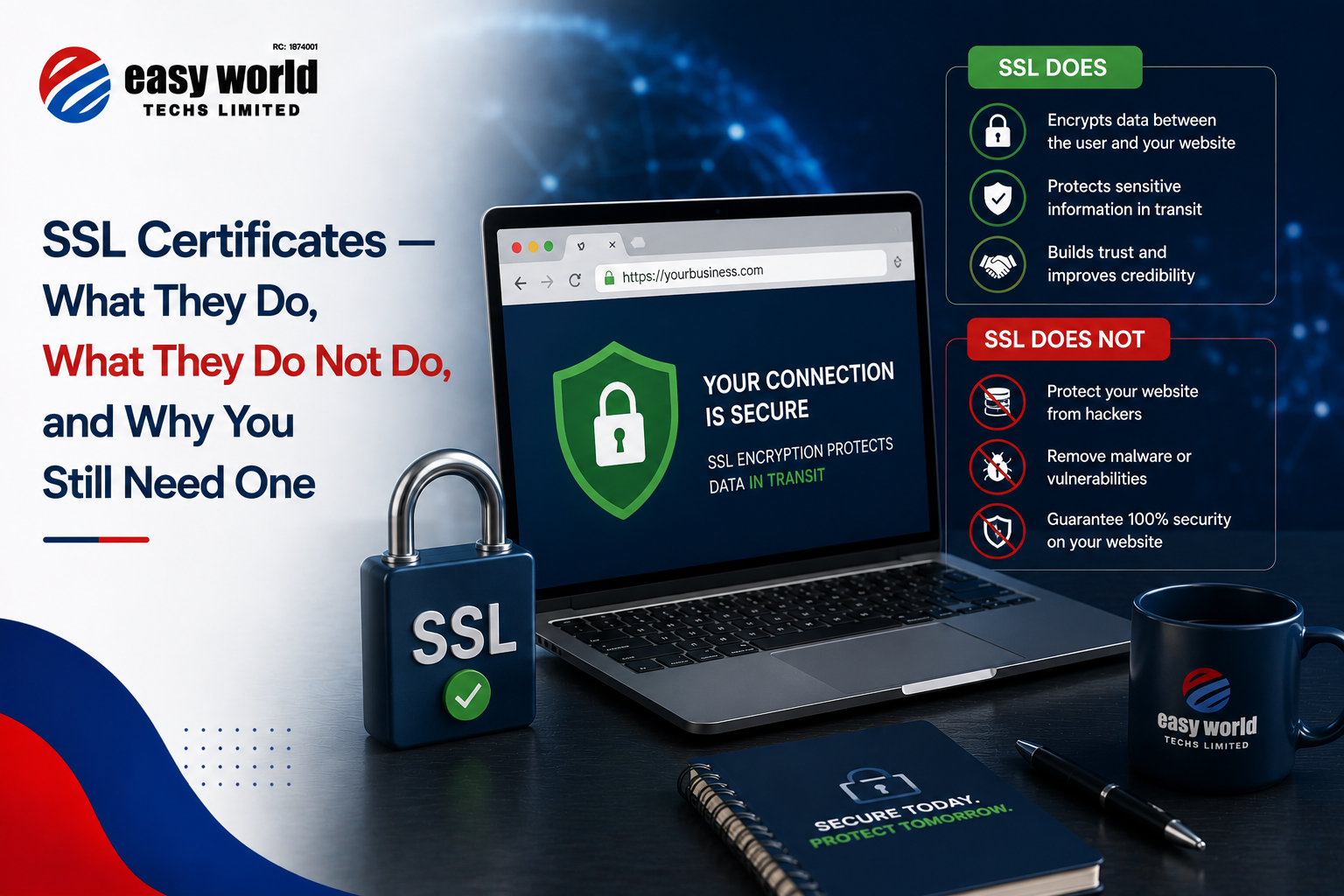
If you have ever noticed the small padlock icon that appears in your browser address bar when you visit a website, you have already encountered SSL in action. Most people see it and move on without thinking about it. But if you run a business website and that padlock is missing, some of your visitors are noticing — and a portion of them are leaving because of it.
SSL certificates have become one of those things in web development that nobody debates anymore. You need one. Full stop. But there is a lot of confusion about what they actually do, and more importantly, what they do not do. That confusion leads some business owners to treat an SSL certificate as a security solution when it is really just one small piece of a much larger picture.
Let us clear it up properly.
What SSL Actually Is
SSL stands for Secure Sockets Layer, though the technology in use today is actually its successor, TLS — Transport Layer Security. The industry kept the SSL name largely out of habit and familiarity, so when someone says SSL certificate they almost certainly mean TLS. The distinction matters technically but not practically for this conversation.
What an SSL certificate does, at its core, is encrypt the data travelling between a visitor's browser and your web server. When someone visits your website, information moves back and forth constantly — pages loading, forms being submitted, login credentials being entered, payment details being processed. Without SSL, that data travels in plain text. Anyone positioned between the user and your server — on the same public WiFi network, for instance, or at the level of an internet service provider — could theoretically intercept and read it.
With SSL, that data is encrypted before it leaves the browser and can only be decrypted by your server. An intercepted transmission looks like meaningless scrambled characters to anyone who captures it without the correct keys.
That is the fundamental job of an SSL certificate. Encryption of data in transit.
What Happens When You Have One
The visible signs are familiar. Your website address changes from http:// to https:// — that S standing for secure. The padlock appears in the browser bar. On some browsers, particularly older versions, you might see the word "Secure" displayed explicitly next to the address. On Chrome and other modern browsers, the absence of HTTPS now triggers a "Not Secure" warning in the address bar, which is a significant deterrent for visitors who notice it.
Beyond the visual indicators, having an SSL certificate is a confirmed ranking factor for Google. It is not the most powerful SEO signal but it is a direct one — Google has stated publicly that HTTPS is a ranking consideration, meaning a site without SSL is at a measurable disadvantage in search results compared to an equivalent site with it.
There is also the trust dimension, which is harder to quantify but very real. People have become conditioned, whether they understand the technical reasons or not, to look for the padlock before they share any information with a website. For a business that collects contact form submissions, processes payments, or handles login accounts, a missing SSL certificate creates a visible trust gap at exactly the moment you need your visitor to feel most confident.
What SSL Does Not Do
This is the part most people get wrong and it matters.
An SSL certificate does not make your website secure. It makes the connection between your visitor and your server secure. Those are meaningfully different things.
Think of it this way. If someone sends you a letter in a sealed, tamper-proof envelope, the envelope protects the contents during transit. But if the building the letter is delivered to has unlocked doors, broken windows, and no security inside — the sealed envelope did not make that building safe. It just protected the letter on its way there.
Your server is the building. SSL is the envelope. What happens inside the building is a separate matter entirely.
A website can have a valid SSL certificate and still be running outdated software riddled with known vulnerabilities. It can have weak passwords on the admin panel that anyone could guess. It can have plugins or themes that have not been updated in two years and are actively being exploited by automated attack tools scanning the internet. It can have no firewall, no malware scanning, no backup system, and no monitoring. The padlock in the browser will still be there through all of it, because the padlock only tells you about the connection, not the destination.
This is why SSL certificates and website security are related but not synonymous. Treating them as the same thing leads business owners to a false sense of security that can be genuinely dangerous. We have had conversations with clients who were surprised to learn their hacked website had a valid SSL certificate the entire time the breach was happening. The data flowing between users and the server was encrypted perfectly. The server itself was compromised.
SSL is necessary. It is not sufficient.
The Other Thing SSL Does Not Guarantee
A padlock does not mean the website behind it is legitimate or trustworthy in a broader sense. Fraudulent websites, phishing pages, and scam operations can and do obtain SSL certificates — because certificates are issued based on domain validation, not on whether the business behind the site is honest or even real.
This is worth knowing both as a business owner and as someone who uses the internet generally. The padlock tells you that your connection to that website is encrypted. It tells you nothing about whether the website itself is what it claims to be. Verifying the site you are on is still a human responsibility. Cybercriminals understood this distinction long before most regular users did.
Why You Still Absolutely Need One
None of the above should suggest that SSL certificates are not important. They are important — they are just not the whole story.
For a Nigerian business website in 2025, operating without HTTPS is not a neutral choice. It is an active negative signal. Visitors see the "Not Secure" warning and make a snap judgment about your business before reading a single word of your content. Google's ranking systems factor it in. Any data your visitors submit through contact forms or login pages is genuinely exposed without it. And for any website processing payments, it is not optional at all — payment processors including Paystack and Flutterwave require HTTPS as a baseline condition for integration.
The cost argument for skipping it has also largely disappeared. Free SSL certificates through services like Let's Encrypt are widely available and most reputable hosting providers offer them as a standard inclusion. There is very little reason to be running a business website on HTTP in an era when HTTPS costs nothing to implement.
Get the certificate. Configure it correctly so your site redirects all HTTP traffic to HTTPS automatically. Make sure it renews before it expires — an expired SSL certificate triggers browser warnings that are arguably worse than having none at all, because they actively alarm visitors who have already arrived. Then treat it as the baseline it is and focus the rest of your security attention on the things that protect what is actually on your server — your software updates, your access controls, your backups, and your monitoring.
The padlock is the beginning of the conversation about your website's security. Not the end of it.
Easy World Techs Limited helps businesses across Nigeria build websites that are not just well-designed but properly secured and maintained.