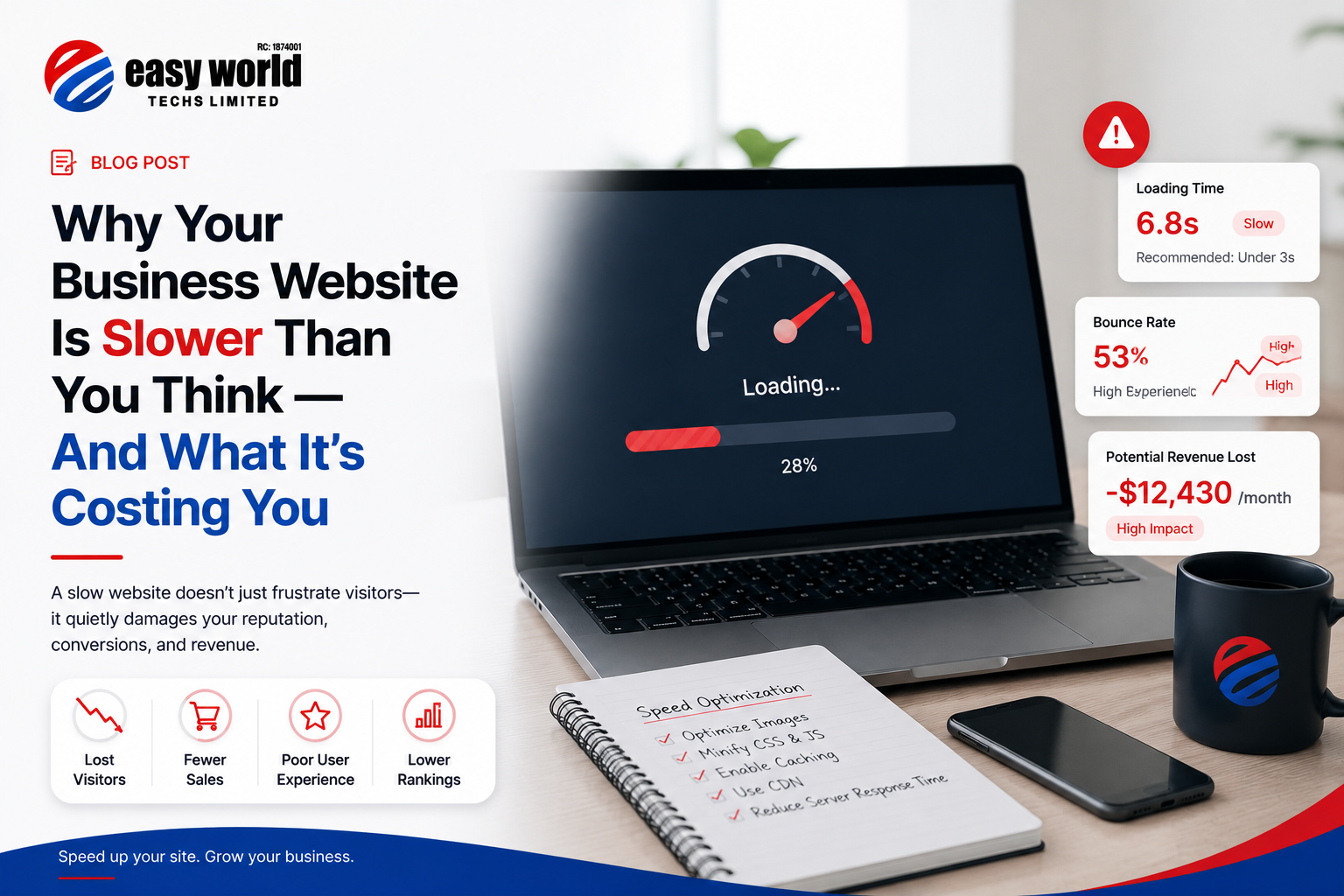
You open your own website and it loads fine. So you assume everyone else is having the same experience. That assumption is costing you customers and you probably do not even know it.
Here is the reality. You load your website quickly because your browser has already cached most of it from the last time you visited. A fresh visitor — someone who has never been to your site before — is downloading everything from scratch. Images, fonts, scripts, stylesheets, all of it. And depending on how your site was built and where it is hosted, that experience can be painfully slow.
The Numbers That Should Make You Pay Attention
Google has studied this extensively. A one-second delay in page load time can reduce conversions by up to 7%. If your site takes more than three seconds to load, more than half of mobile visitors will leave before it even finishes loading. They will not wait. They will go back and click the next result.
In Nigeria, where a significant portion of internet users are on mobile data rather than broadband, this problem is even worse. A site that loads in two seconds on a Lagos office fibre connection can take eight seconds on a mobile network in Port Harcourt. Same website. Completely different experience.
How to Actually Check Your Website Speed
Stop guessing. There are free tools that give you a real picture in under a minute.
Google PageSpeed Insights — Go to pagespeed.web.dev, paste your URL, and run the test. It gives you a score for both mobile and desktop and tells you exactly what is slowing things down in plain language. Do the mobile score first. That is the one that matters most for most Nigerian businesses.
GTmetrix — Gives you a waterfall breakdown of every single resource your page loads and how long each one takes. It is more technical but incredibly useful for identifying specific problem files.
WebPageTest — Lets you test your site from different locations and connection speeds. Test it from a slow 3G connection and see what your average mobile visitor is actually experiencing.
Run your site through at least one of these right now. Whatever score you get, there is a good chance you will be surprised.
What Is Usually Causing the Slowness
Images that were never optimised. This is the most common culprit by far. Someone uploads a 4MB photo from their phone directly to the website and it sits there bloating every page load. Images should be compressed and served in modern formats like WebP. A 4MB image can often become 200KB with no visible quality difference.
Cheap or poorly located hosting. If your website is hosted on a shared server based in the United States or Europe, every request your Nigerian visitor makes is travelling across the Atlantic and back. That latency adds up. Hosting location matters more than most people realise.
Too many plugins. WordPress sites in particular suffer from this. Every plugin adds weight. Many sites are running fifteen to twenty plugins when five would do the same job. Each one loads its own scripts and stylesheets whether you need them on that page or not.
No caching configured. Without caching, your server rebuilds your web page from scratch every single time someone visits. With caching, it serves a pre-built version instantly. It is one of the simplest performance improvements available and many sites are not using it.
Unminified code. CSS and JavaScript files contain spaces, comments, and formatting that make them readable for developers but add unnecessary file size for browsers. Minifying those files — stripping out everything the browser does not need — reduces their size and speeds up load time.
What Slow Loading Actually Costs a Business
Beyond the user experience frustration, a slow website hurts you in measurable ways.
Google uses page speed as a ranking factor. A slow site ranks lower in search results than a faster competitor with otherwise similar content. You could be losing organic traffic to a competitor simply because their site loads faster.
For e-commerce or any site where visitors take actions — filling a form, making a purchase, booking a service — every extra second of load time is friction. Friction kills conversions. A site that loads in one second can convert significantly better than the same site loading in four seconds, with no other changes made.
And there is the brand perception angle. A slow, clunky website signals to a visitor — consciously or not — that the business behind it is not particularly serious. It is unfair but it is true. Your website is often the first experience someone has with your business. That experience forms an impression in seconds.
Quick Wins You Can Do Today
If you are not in a position to do a full technical overhaul right now, there are a few things that make a noticeable difference quickly.
Run your images through a free compression tool like Squoosh or TinyPNG before uploading them. This alone can dramatically reduce your page weight.
If you are on WordPress, install a caching plugin like WP Super Cache or LiteSpeed Cache. Configure it and your repeat visitor experience improves immediately.
Ask your hosting provider where your server is physically located. If it is not in Africa or at least closer to your primary audience, it may be worth discussing a migration or at minimum setting up a CDN.
When to Bring in Help
Some of this you can handle yourself. But if your PageSpeed score is below 50, if your site takes more than four seconds to load on mobile, or if you have already tried the quick fixes and nothing has moved — it is time to get a developer to do a proper performance audit.
A thorough audit looks at your hosting environment, your code, your asset delivery, your database queries, and your third-party scripts. It gives you a prioritised list of what to fix and in what order for the biggest impact.
It is not glamorous work but the results show up directly in your traffic, your conversions, and your search rankings.
At Easy World Techs Limited, we build websites that are fast by default — not as an afterthought. If you want your site audited or rebuilt with performance in mind, get in touch.