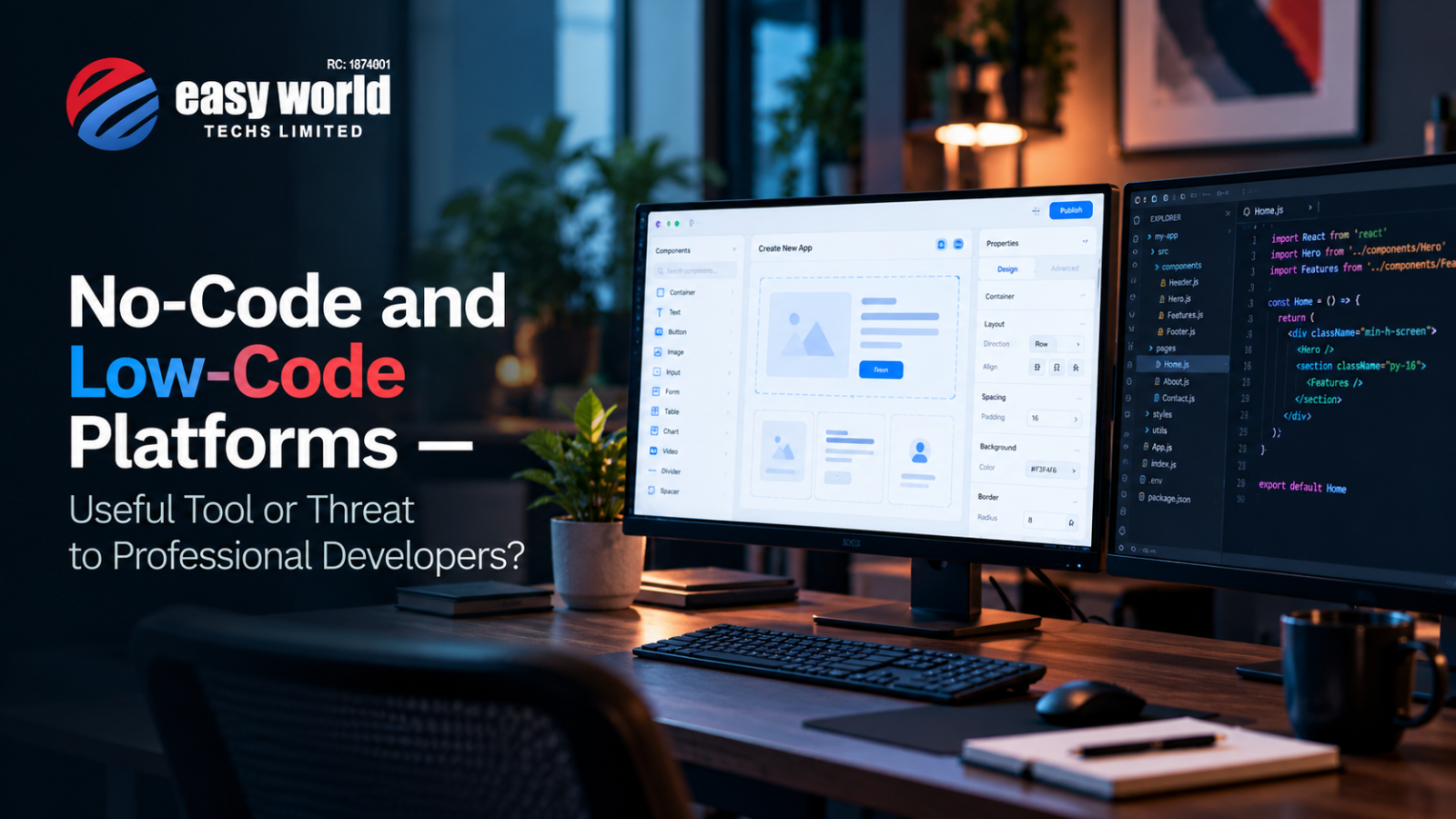
Every few months, someone asks us a version of this question with a slightly nervous edge to it — usually a developer, sometimes a client wondering if they even need us. "Should I just build this on Bubble instead of hiring a developer?" Or, from the other direction: "Is no-code going to make what you do obsolete?" Both questions come from the same place, and both, honestly, deserve a more nuanced answer than either the no-code evangelists or the developers dismissing it entirely tend to give.
We'll say upfront where we land, and then explain why, because we think the honest answer is more useful than a diplomatic one: no-code and low-code platforms are genuinely useful for a specific, narrower set of problems than their marketing suggests, and they're not a threat to professional development so much as a filter — they're pulling a certain category of work away from developers, while leaving, and in some ways expanding, the category of work that actually requires one.
What No-Code Actually Is, Stripped of the Hype
Platforms like Bubble, Webflow, Glide, and Adalo let you build functional apps and websites through visual interfaces — dragging elements, connecting them with logic, configuring databases — without writing traditional code. Low-code sits a step further along, offering visual tools alongside the ability to drop into actual code when the visual tools hit their limits. The pitch, repeated in every piece of marketing for these tools, is that anyone can build a real product without a developer.
There's real truth in that pitch, and it's worth taking seriously rather than dismissing out of professional self-interest. We've seen founders build genuinely functional MVPs on Bubble in weeks — booking tools, simple marketplaces, internal dashboards — that would have taken a custom development team months and a budget most early-stage founders don't have. For testing an idea, for validating whether people actually want something before investing serious money into building it properly, no-code is often the right call, not a compromise.
Where It Actually Breaks Down
The honest limitation shows up later than most founders expect, which is exactly why it catches people off guard. No-code platforms handle simple, well-defined logic well. They start to strain the moment your product needs genuinely custom behavior — complex business logic specific to your industry, integrations with systems the platform doesn't natively support, performance at real scale, or anything involving sensitive data handling that needs to be architected carefully rather than configured through a template.
We've had more than one founder come to us after building on a no-code platform for a year, having grown a real user base, and hit a wall that had nothing to do with their business model and everything to do with the platform underneath it — slow load times as their data grew, a specific payment flow the platform genuinely couldn't support, or a monthly platform bill that had crept up to a size where custom-built infrastructure would have been cheaper. Migrating off a no-code platform at that stage is a real project — often more expensive and disruptive than building the same product properly from the start would have been, because now you're not just building, you're also untangling years of data and workflows from a system designed to keep you inside it.
This isn't a criticism of the platforms so much as an honest description of what they're optimized for. They're optimized for speed to a working product, not for the product's fifth year of operation at scale. Treating them as a permanent foundation rather than a fast way to test an assumption is where the mismatch happens.
The Actual Effect on Developers, and Why "Threat" Is the Wrong Word
Here's where we'll push back on the framing in the question itself. No-code hasn't made professional developers less necessary. It's changed what the entry point to needing one looks like. A decade ago, if you wanted to test a business idea, you often needed a developer from day one, for even the simplest version of a product. Now, plenty of founders can get that first version built themselves, cheaply, and only bring in a developer once they've proven the idea has legs and need something the no-code platform can't deliver.
From where we sit, that's not a threat — it's arguably a better filter. The clients who come to us after outgrowing a no-code platform tend to be better clients than the ones who come to us with only an idea and no validation, because they already know their product works, they already understand their users, and the conversation is about building something properly rather than guessing whether the idea has merit at all. The work shifts toward more complex, higher-value problems — the kind that actually need a developer's judgment, not just their typing speed.
What has genuinely declined, and this is worth being honest about, is demand for the simplest tier of development work — basic landing pages, simple form-based tools, straightforward booking systems with no unusual requirements. If that's the entirety of what a developer offers, no-code platforms are legitimate competition, and pretending otherwise would be dishonest. The developers and agencies actually affected by no-code adoption are the ones who were competing on speed and simplicity for simple problems. The ones building genuinely complex, custom systems aren't feeling much pressure from tools built explicitly not to handle that complexity.
So Which Should You Actually Use?
If you're a founder trying to validate whether an idea has real demand before committing serious money, and your product's core logic is reasonably standard — a marketplace, a booking system, a simple internal tool — start with no-code. It's faster, cheaper, and genuinely capable of getting you real user feedback fast enough to know whether to keep going. Just go in with eyes open about the migration conversation you'll likely need to have later if it works.
If your product involves complex, industry-specific logic from day one, needs to integrate deeply with systems no-code platforms don't support well, or handles data — financial, medical, personally identifiable — where architecture and security decisions genuinely matter, skip the no-code detour. You'll likely end up rebuilding from scratch anyway, and the interim platform costs will have bought you less validation than you think, relative to what a properly scoped custom build from the start would have delivered.
Neither path is universally right, whatever either side of this argument tends to claim. The honest answer is that no-code and professional development aren't really competing for the same jobs — they're solving different-stage problems, and the businesses that navigate this well are the ones that know which stage they're actually in.